
Life Achievement Award 2022 ceremony
The speeches and a wonderful ceremony
Awarded Sept. 2nd, 2022, at the Summer School 2022 / KISTE project workshop: “Open Source solutions for Earth system data (R, OSGeo, Python)”, 28 August 2022 – 03 September 2022, Siegburg, Germany
https://opengeohub.org/summer-school/siegburg-2022/
Opening by Tomislav Hengl
When the moment comes, when there is a right moment, we give a Life Achievement Award. We discussed this within our scientific committee and we all agreed that this year we would like to give the Life Achievement Award to our dear colleague, Markus Neteler, who is here with us, including his colleagues. So we are very happy to give Markus Neteler a Life Achievement Award and there will be some speeches, so there are some surprises coming.
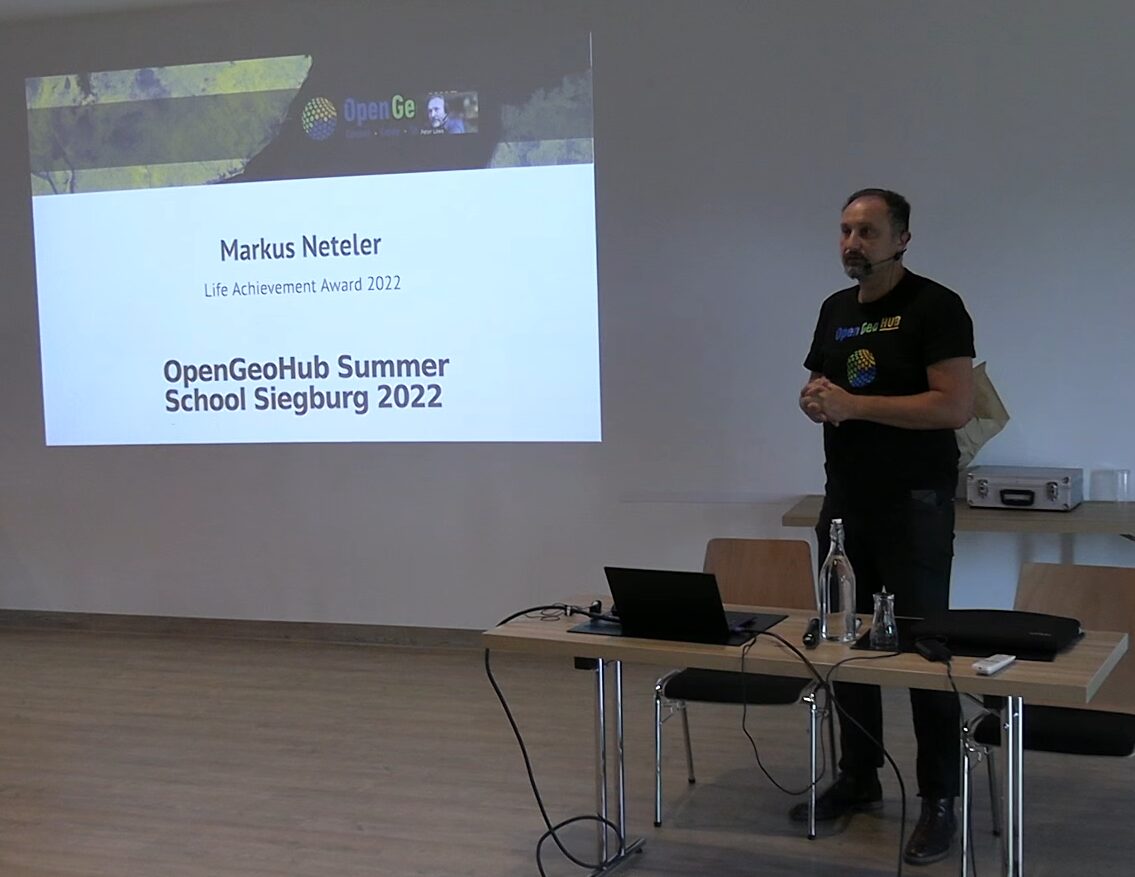
Life Achievement Award 2022 ceremony opening
We also took some old photos of you to embarrass you and we also have a nice souvenir for you to share with your family, but basically we are really grateful to Markus for everything you have done through your whole life and especially to your contributions to the open source community and to help enabling researchers and also both developing software and data. So we are really grateful and you have been to many summer schools with us and there are many videos now of you and we really appreciate it. So I just want to say a few words about Markus.
So for those of you maybe that are not familiar, Markus was not in this summer school, but I think if you google his name you will see that he is still one of the main contributors to the GRASS GIS and he is one of the founding members of the GRASS User Association, which is one of the world’s most known open source GRASS software. He also contributes to the open source OSGeo Foundation and he won also, I see on your Wikipedia page that you won the Sol Katz award and you have as I said participated in many cou rses and conference workshops and of course now summer school.
Yes, we contacted most of the people that you know, we contacted to contribute today and to say some words about you personally and professionally and also to bring some embarrassing photos of course and we put that in a slide all together so I am sure it is going to be a bit of a surprise and as you see Peter Loewe is also connected online and he also wants to say some things about you, probably didn’t know he would be connected.
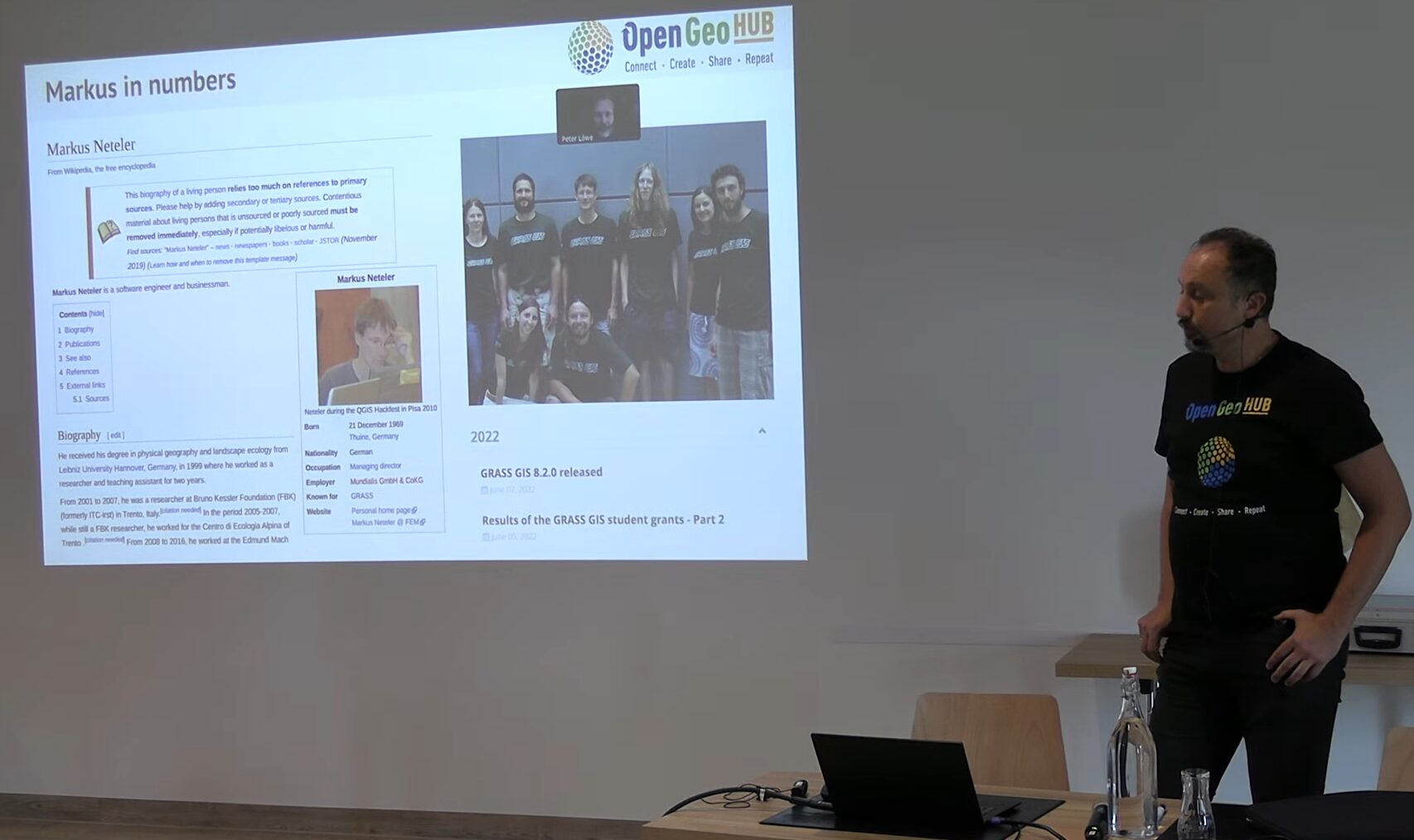
Life Achievement Award 2022 ceremony for Markus Neteler
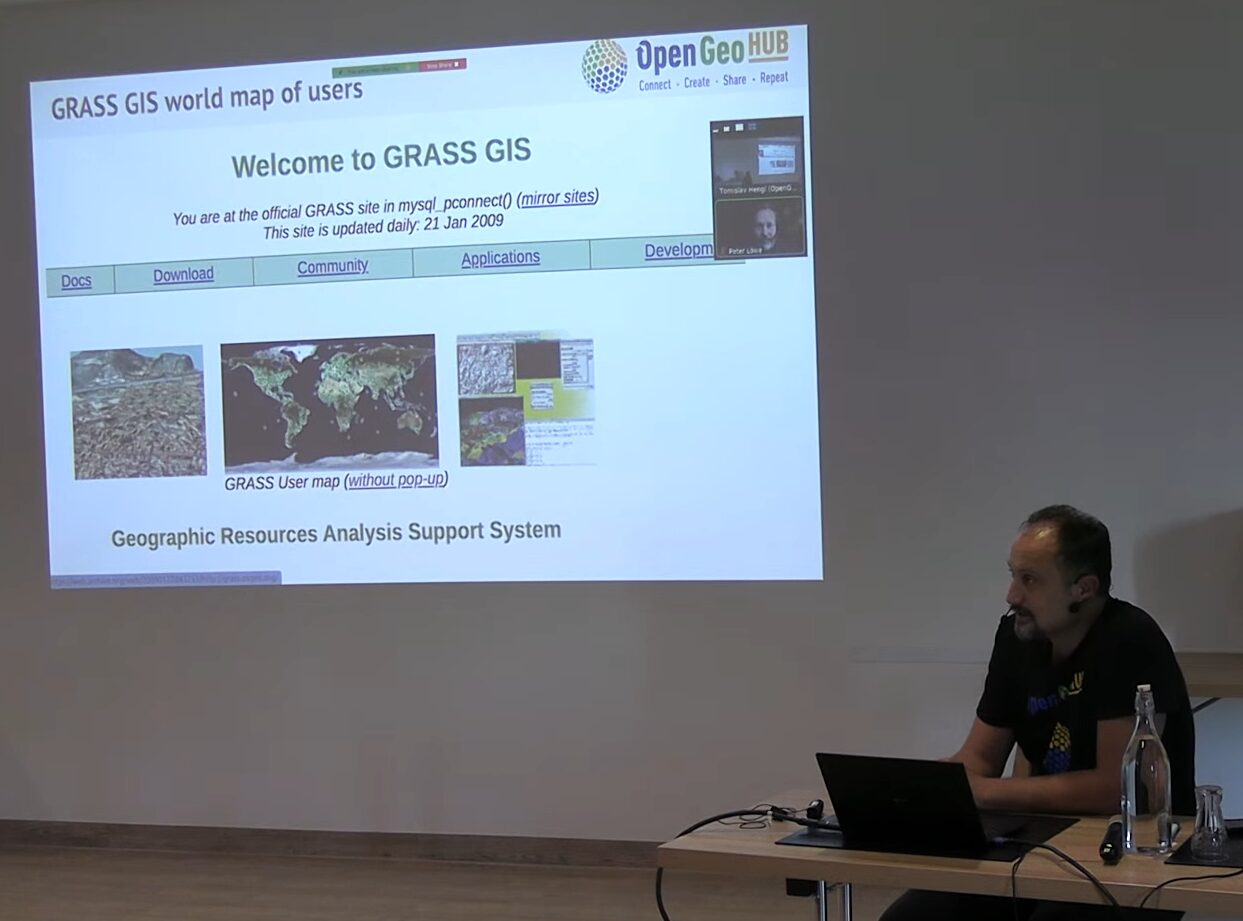
GRASS GIS history
So I looked at all your outputs and I have to say my bet will be that your biggest outputs are really starting with this book, the open source GRASS GIS Approach, which is still top rated on Google Scholar and so let’s say that is one of your major achievements and it is a really fantastic book. But you also contributed to several other books that have sections on GRASS GIS and also you contributed to the Gmorphometry book, back in 2010-11, so you have quite some contributions in science and we also looked at the GRASS GIS map of users, we tried to rebuild the map so we can see and you see it is a bit difficult to see but the dots are really all around the planet so it is a really global GIS, it is not only used in Europe but it is really across continents and it is really thanks to the book you made and the software you made and now there is GRASS GIS version 8 so the story continues and there is a big community so it is something that will stay, it is your legacy and so just to congratulate you on that.
The audience is listening
And now I would like to pass the floor to your colleague Peter Loewe who wants to say a couple of words about you and Peter from your side you can also share the screen, we are now on the big screen as you see but you can also share the screen and if you need help with anything I can open it on my computer.
Speech by Peter Loewe
Keynote by Peter Löwe (remote)
Thank you so much choosing me to do the honors for Markus. This really means much to me, as I’ve been watching and admiring the unlikely career of Markus unfold since the late 1990s. So this is a rather personal account.
Since NetFlix has become so good at turning real live stories into movies, I am certain that they either already have one in the works on Markus, or better start soon. The renaissance of open source geospatial, with an emphasis of Markus’ central role in this, will be an adventure-filled technology-thriller, about software and the internet, Generation X, building start up companies, cliffhangers, worldwide travel, friendship and partying, but also carving out a niche in the face a seemingly all dominant business empire.
Looking back it might appear that Markus career was always a self-fulfilling prophecy, but it was rather a quest into uncharted territory and at times an uphill battle, while no one really knew for certain if there was actually a hill with a peak to begin with.
Today we’re apparently standing on top of that hill of geospatial and can admire Markus’ path to success. I want to take you briefly back in time to the humble beginnings, to emphasize how fragile, challenging and unlikely Markus career and the budding field of open geospatial were just around the turn of the Millenium.
Markus and I crossed paths about a quarter of a century back, in Germany. I was doing my PhD in a research project from hell which involved field work in South Africa and collaboration with the south African Weather Service. These were the days when illegal software copies of things like E$R! ArcV!ew were plentiful among students and faculty, but that was no option when collaborating with an official South African Institution.
So I used this new tool “Google” and discovered GRASS 4.2.1 on FTP – all integer, but better than nothing ! The Name “Neteler” kept coming up in that context, time and time again. So eventually I reached out and learned that a GRASS User Association had just formed, with a first meeting coming up. I joined this GRASS Association (December 2001) as the first non-founding member and headed to the first meeting, where allegedly, “the developer”, that’s Markus, should be present – which he was.
Since GRASS already was sufficiently complex in those days I had expected Markus to be an esteemed wise elder technology guru like Richard Stallmann or wizened Professor well established at the U of Hannover. To my surprise we were about the same age and he was also busy to get a foothold in German academia and just stake out a career.
The time around the Millenium was exciting. It was great to be part of the growing German GRASS community, or rather, family. There were other geospatial tribes emerging, like Mapserver, R, and companies being created. Everything seemed possible and during the annual GRASS Association BBQs and nightly festivities which followed the dreaded annual official association meeting on the university grounds in Hannover, we were absolutely certain that in ten years (by 2012), or less, all school children wouldn’t just learn foreign languages such as English, Spanish and French, but EVERYBODY would also be fluent in computing languages like Java and Perl. Again, the angle towards the future was a bit over optimistic then.
It is still beyond me, why the U of Hannover would allow such a brilliant and motivated young mind to leave. To persue his academic career, Markus and family relocated to Trento, Italy. There he got busy immediately, gathering like minded people to establish a local GRASS community, which would later spread all across Europe, and to reboot in 2002 the GRASS Conference Series which had been dormant since the 1980s with an international event at the University of Trento. The conference was small, but highly innovative. They even already did video recordings, which got preserved as part of the record of science (Open source GIS – GRASS user conference 2002. University of Trento, https://doi.org/10.5446/s_291).
So you all can go back and have a look how little Markus actually has changed since then (Neteler, Markus: Current status and future development of GRASS. Open source GIS – GRASS user conference 2002, University of Trento, 2002. https://doi.org/10.5446/21784). Neither by looks, kindness or determination.
To get to Italy for that conference was a challenge for me. Academia and society weren’t yet ready for open source geospatial: I hadn’t finished my PhD and was temporarily unemployed. So I approached my University for gas money since I was to give a presentation on my research, but they declined. Then I approached the unemployment agency for the same. They thanked me for letting them know that I was apparently going on some kind of vacation, so they would reduce my monthly unemployment check accordingly. In the end, me and a brother from the GRASS Association shared the gas money and roadtripped to Italy, where Markus and his wife Eva gave us shelter in their small apartment in Trento during for the conference.
Those were the days. In parallel to his research in Italy, Markus and former colleagues from the U of Hannover founded his first startup company GDF-Hannover, where they offered GRASS GIS related training, literature and consulting.
Looking back, two more events stand out as pivotal. One is the first FOSS4G conference in Bangkok in 2004, where Markus and I, among other things, presented a pilot of live Linux distribution wrapped around GRASS GIS. On one of the images on the picture gallery you can see the two of us in Bangkok with our poster. While the Trento conference had mainly brought together a new generation of European researchers interested in GRASS and Open Source, the Bangkok event really put it back on the global scale.
This line still continues, with this years FOSS4G in Florence, Italy just two weeks ago. I’ll finish this trip to memory lane with the FOSS4G conference four years later in 2008 in Cape Town, South Africa. By then, open source geospatial was clearly not a thing of the global north anymore. It was an excellent conference, but what they really have to put in that Netflix movie is the evening when Markus, our friends Sylvia and Andrea from Hydrologis from Bolzano and me as the driver stole away to the beach to marvel the stunning vista of the changing colors of Table Mountain while the sun was slowly setting over the ocean. That moment, while we stood in the surf with our feet wet, we felt we were truly standing on the shoulders of these giants and all our past efforts had paid off.
But enough of the past: We’re here to celebrate Markus Neteler and apart from his crucial role to establish open source geospatial as a societal phenomenon, he’s a man of many talents: He’s a father, a husband, a musician, an entrepreneur, a coder, a community builder, a role model, a great friend – and a tough nut to overcome all challenges that life throws at him. He’s a true renaissance man by any means.
But there’s still one thing which still puzzles me after all these years – I really wonder if he ever sleeps. You find him every day of the week tirelessly answering user questions big and small on the GRASS mailing lists, while at the same time he’s busy on developer lists for other software projects to coordinate the evolvement of Open Source Geospatial as whole. And he runs his business – and the family.
In open source geospatial, we are all standing literally on the shoulders of Giants, which are the coders and community activists which paved the way for our work. Among us, the current generation, slowly greying, Markus stands out as a humble, gentle but determined Titan. I hope eventually we’ll see bronze statues of him in Hannover, Trento, Bonn and the places he will visit in the years to come.
Markus, congratulations to this award, which is overdue and so well deserved.
Thanks for listening.
(Citation edit 2026: Löwe, P. Markus Neteler Lifetime Award Address. Zenodo. https://doi.org/10.5281/zenodo.20611011)
Tom Hengl moderation
Thank you, Peter. That was really, really exciting story and very personal. Thank you so much for preparing that. Please, if you want to share that text, please send it to us. We will make a page on today and on the Life Achievement Award. So we will collect all the material. So please, after this, you can send me the whole story and we will incorporate it. I will share my screen so you can also see what is happening.
So next person I would like to call is Professor Edzer Pebesma, who is head of the scientific board of openEO Hub. Also prepared a little speech for you, surprise.
Speech by Edzer Pebesma
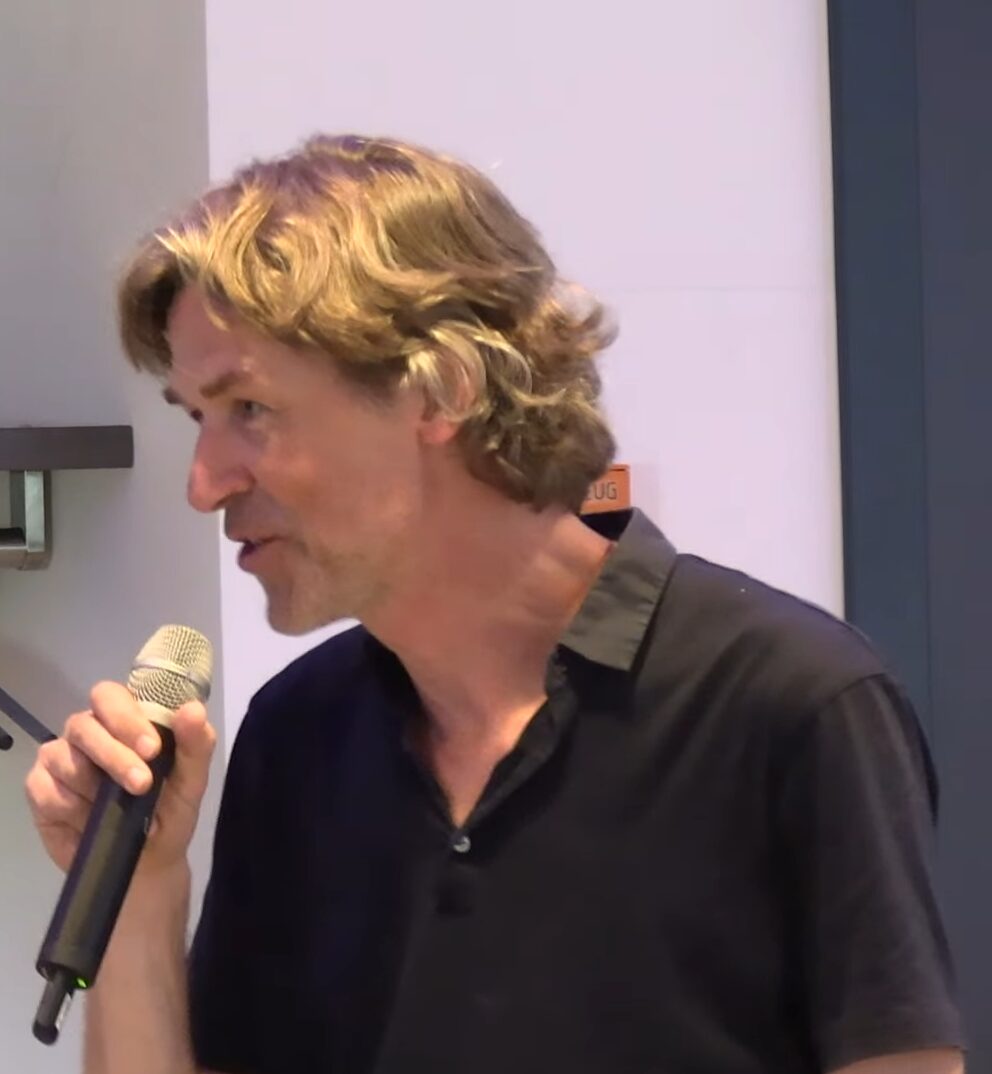
Keynote by Edzer Pebesma
Thank you, Tom. This is rather spontaneous. Hi, Peter, and thanks for your beautiful speech. I wasn’t raised in Germany, so I can’t hold speeches like that. But I wrote down a couple of words on this occasion.
So, when did you touch for the first time GRASS, Markus? 1992.
Aha, aha. But I’m older than you, right? Well, I ran into it in 1989. I was still at school. There was a machine bought in my institute that actually ran, so GRASS was released by the U.S. Army and could be used in academia. So my institute bought a machine, especially a special machine, for the big MASS core, the Scotland MASS core. It made a lot of noise. And it ran GRASS, right? When people were computing, I was not allowed to touch it. I was still a student. But it was impressive. And at one day, the cleaning person actually was cleaning the room and touched the electricity cable, and it came out, and the machine went down and never went up again. So that was the end of GRASS in my institute.
These things happened. But anyway, the first time we ran into each other, in 2003, I’m not sure, but that was Vienna, the famous sort of booting of R-Spatial, where Roger Bivand called together a lot of people working in R and spatial and in GRASS and space and other things with the idea that if we sit together, then we can do good things. And good things came out. So that was very nice. It was collocated with what later became the UseR, and it was called the Distributed Statistical Computing Conference in Vienna. So that was a very nice occasion with a lot of new meetings.
After 2007, since what was back then called the Geostat Summer Schools, and later the openEO Summer Schools started working, I think we ran into each other relatively regularly when there were usually GRASS sessions in the summer school, so I haven’t made any recollections when and where, but there was some kind of regularity in that sense.
In 2016, we also sat together. You co-authored what I call the openEO Manifesto, sort of the blog post where the whole thing started with and we’re partnering in the first project, Horizon 2020 project, where we collaborated with a lot of very nice things. I also invited Markus several times to give talks, presentations at my institute, and also try to convince him to apply for open positions when my institute had open positions for which I was never successful.
So apparently he’s doing things that he likes, I conclude. So that’s a good thing. I have some strong connections to Markus, and one of these things is that we share a number of data points.
So one of them is eight, I have no clue, but we must be the more senior types who still code, more senior people who still write code on a nearly daily basis. We both speak Germanic languages natively. We both are skinny and tall, so we both like to make music. We are both interested in open source software development, geospatial and community engagement. We both enjoy working with earth observation data.
I still have a couple of months to go, but then we both have lived 15 years abroad, so I just noted. And we both try to take life lightly.
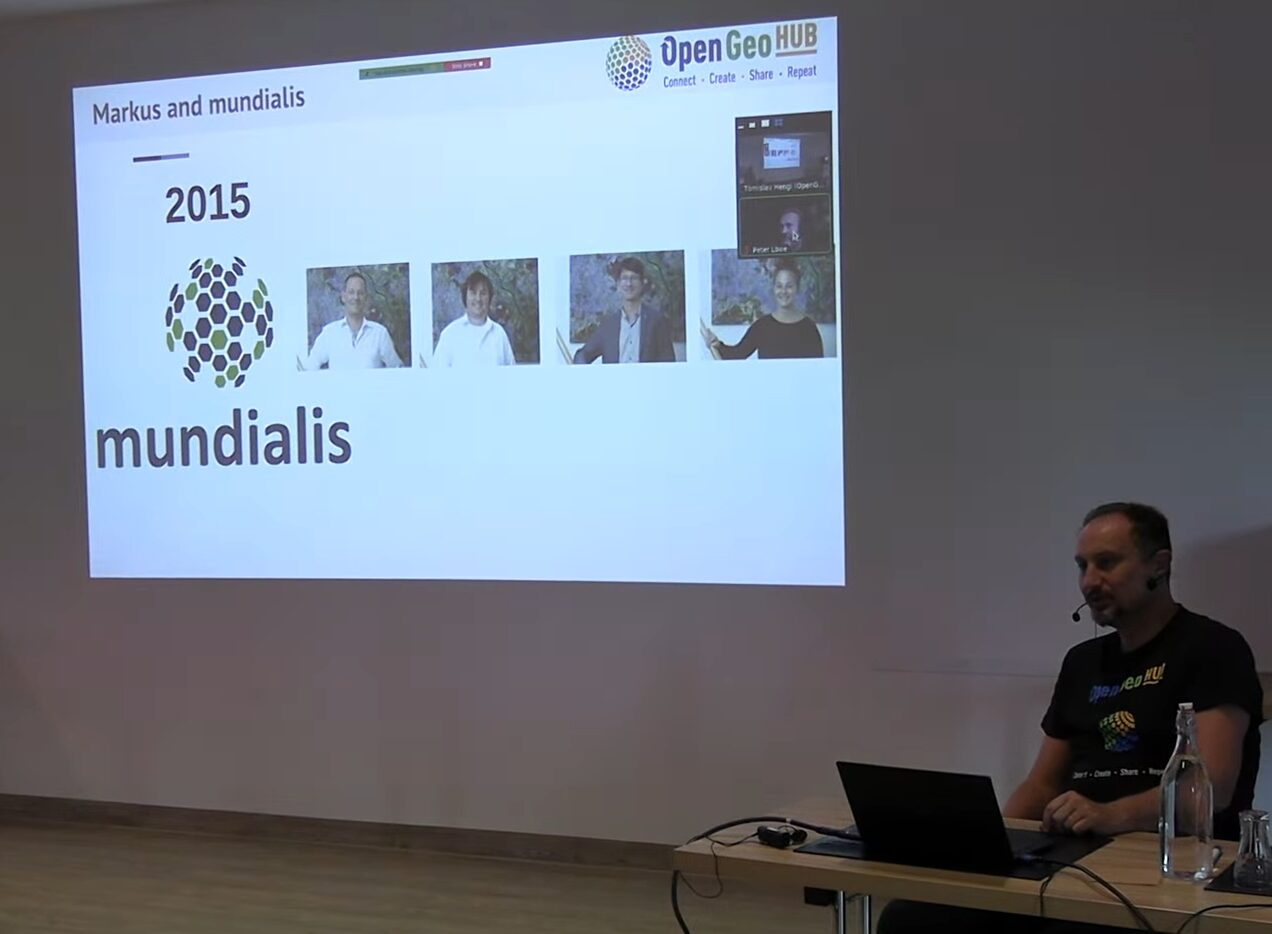
The role of mundialis in Markus’ life
It doesn’t mean that we don’t take it seriously, but that we take it with a grain of humor and so on. So that you can survive things.
Markus is a person whose heart not to like. He is able to connect and to really make contact with people around him in a very uncomplicated way. He speaks from his heart in a way that is hard to miss, I find. And I think that this Open to Europe Lifetime Award is more than well deserved and expresses that you have our deepest appreciation. Congratulations with the achievement.
There will be one more speaker, who I think is also somebody who knows Markus probably the best, especially in the last decade, is his partner and colleague at mundialis, Hinrich Paulsen. Hinrich, please, can you come and say a few words about Markus? Thank you very much.
Speech by Hinrich Paulsen
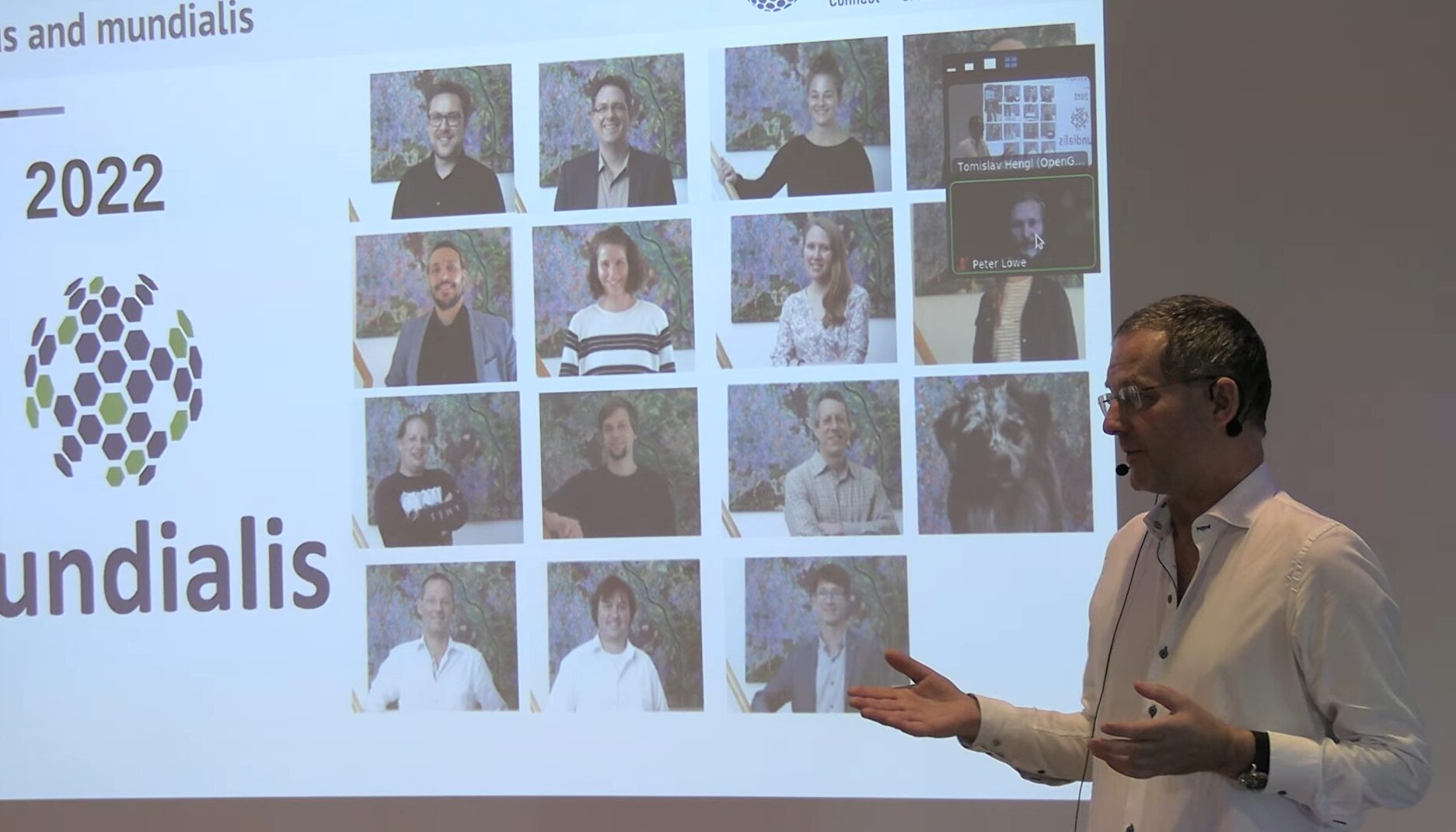
Keynote by Hinrich Paulsen
Well, good afternoon everyone. I’m very happy to be here. My name is Hinrich Paulsen. I would also like to address some words to my dear friend and colleague, Markus.
Actually, I finished my university here in Bonn studying Geography, Geology and Soil Science about 20 years ago, 22 years ago. And obviously when you studied Geography, you come across all these GIS’s and GRASS GIS was mentioned. And then this name Markus Neteler somehow pops up.
And in 2002, I helped found a company called terrestris here in Bonn, dedicated to free and open source software. And then obviously you have to do with all sorts of software packages and QGIS, Map Server and all these things, they keep popping up. And Markus’ name appears and then you hear about FOSS4G , you go to FOSS4G and I never met him, but my partner went there and talked, oh, there’s this guy, Markus Neteler and he’s really cool and he does cool stuff and so on.
So as we progress in 2014, the European Space Agency decided to set up the Copernicus program and we thinking, well, we’re geographers and Earth observation data, that’s something like Geodata. I know that remote sensing people think differently about this, but okay, we thought, wow, that’s a good idea. So we co-founded or I co-founded a company called mundialis and dedicated to the analysis of remote sensing data.
And at this time, my partner went to the FOSS4G Europe in Italy and met Markus and then Markus said, well, I’m not so happy in Italy anymore and so on. And then we started thinking, well, wouldn’t that be great to get Mr. GRASS GIS to join mundialis. And so we started talking and Markus, being a man of many talents, started talking to us and we were absolutely honored that he would actually speak to us and consider this.
And then to cut a long story short, in December of 2015, we actually signed the contract and we said, hey, we’re going to do mundialis together. So there are the three of us, the founders of mundialis, plus our first employee, Carmen Tawalika, young lady fresh from the university, and we set out to conquer the world. And we did. So in 2022, this is what mundialis looks like. And we’ve come a long way.
And it’s been a very personal journey for me with Markus, whom I met in the autumn of 2015, actually here in Siegburg, I picked him up from the train station. He arrived by train to do all this deliberation, whether he would join and so on. And then we ended up in front of my fireplace with a bottle of red wine and we started getting to know each other.
And then in due course, he actually moved his family in 2016 here to Bonn. And then I… No, hang on. Too much. Then I learned about Markus specialties because he would show up in the mornings and say, oh, by the way, I’ve written this piece of code and it will do fantastic stuff and I’ve analyzed some data and this is what we can do with it. And he would, you know, you really have to kind of stop him and say, hey, this is wonderful and how can we manage all this and so on. So this was the first interaction that’s been mentioned before that Markus is sort of very energetic. He has many talents and he really knows his way around the geospatial world. So this is absolutely fantastic to have him as a business partner. And there is also the fact that he’s open to very crazy ideas. This is when we were in Luxembourg talking to the Luxembourg Space Agency with a crazy idea. So he’s even open to that. So besides the own ideas he has, he will go along with many other crazy ideas, which I think is a really fantastic trait.
Now in the face of personal hardships and sometimes his health not doing what it’s supposed to do, he has incredible stamina. So no matter what happens and no matter what life asks of him, he just keeps going. And this is something that I really like about him and it was mentioned before that he has this incredible power to keep going and to do things. And especially when you’re in a business environment, it’s a good character trait to have around you.
And he’s not only tough but he has many talents that he can cook. So it’s always a good thing to have these talents. Plus I think Edzer just said it. He not only takes things with a grain of salt, but maybe also with a Gin tonic, which also helps at the odd occasion. Maybe these pictures are a bit big for the other thing. Not only does he cook well and bake well, but he also likes to eat cake. So there have been many instances where we sat down together and enjoyed some food together.
And maybe last but not least, what we do usually in the mornings at quarter to eight is after the message in the evening biking tomorrow, we meet up and we cycle along the river Rhine. It’s depending on how far we go, something between half an hour and 50 minutes, just cycling, chatting, enjoying the fresh air. And it’s a wonderful, very peaceful exchange. And I’m very grateful for these experiences that we can have.
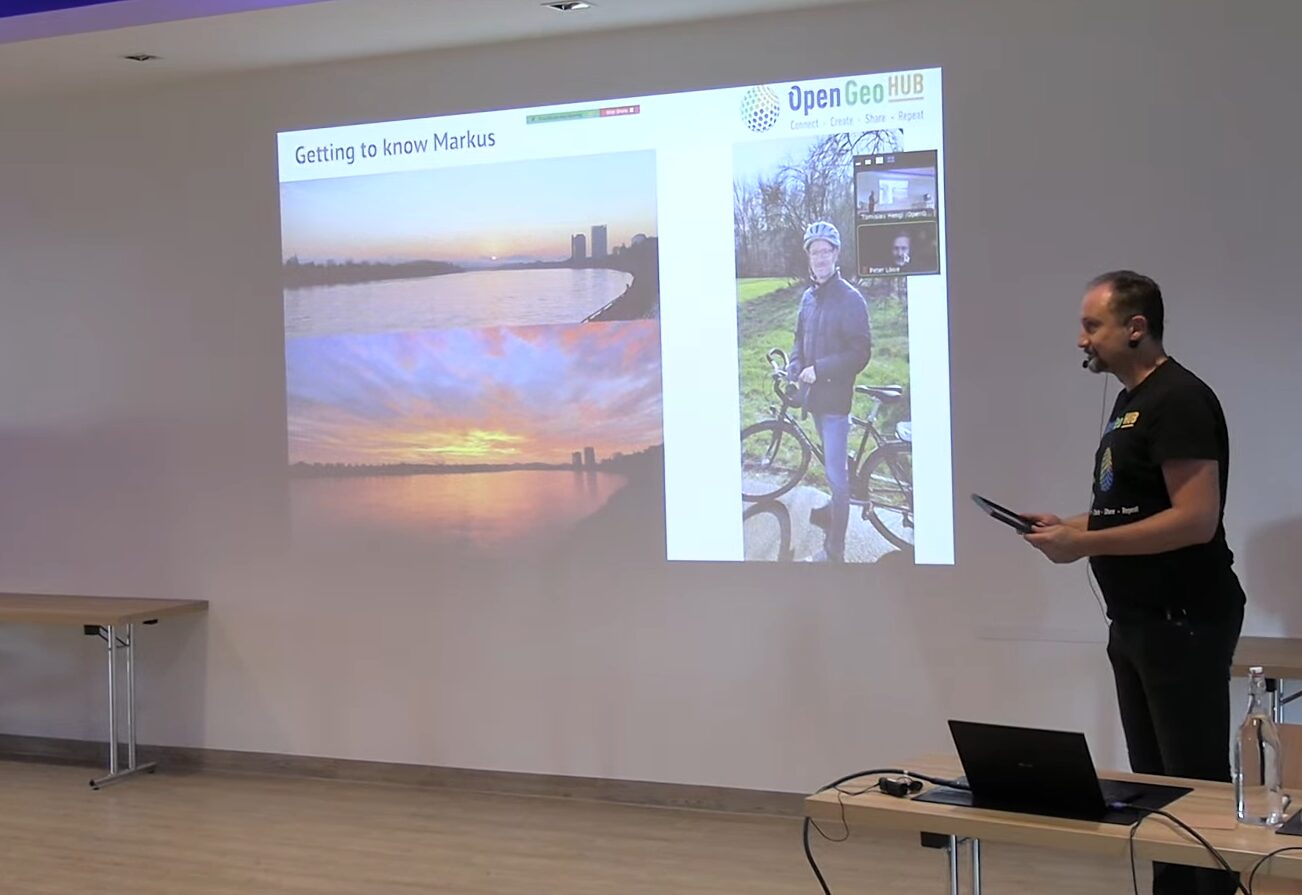
Tom about Markus
And I think this is the last slide. So I would like to finish this little presentation with what Edzer said, what Peter said. You have absolutely deserved the award that you’re being presented today. And beside this official recognition, I would like to say thank you very much for the inspiration and the friendship that I’ve been exposed to over the past years that I’ve been knowing you. Thank you very much. Thank you.
Tom Hengl moderation
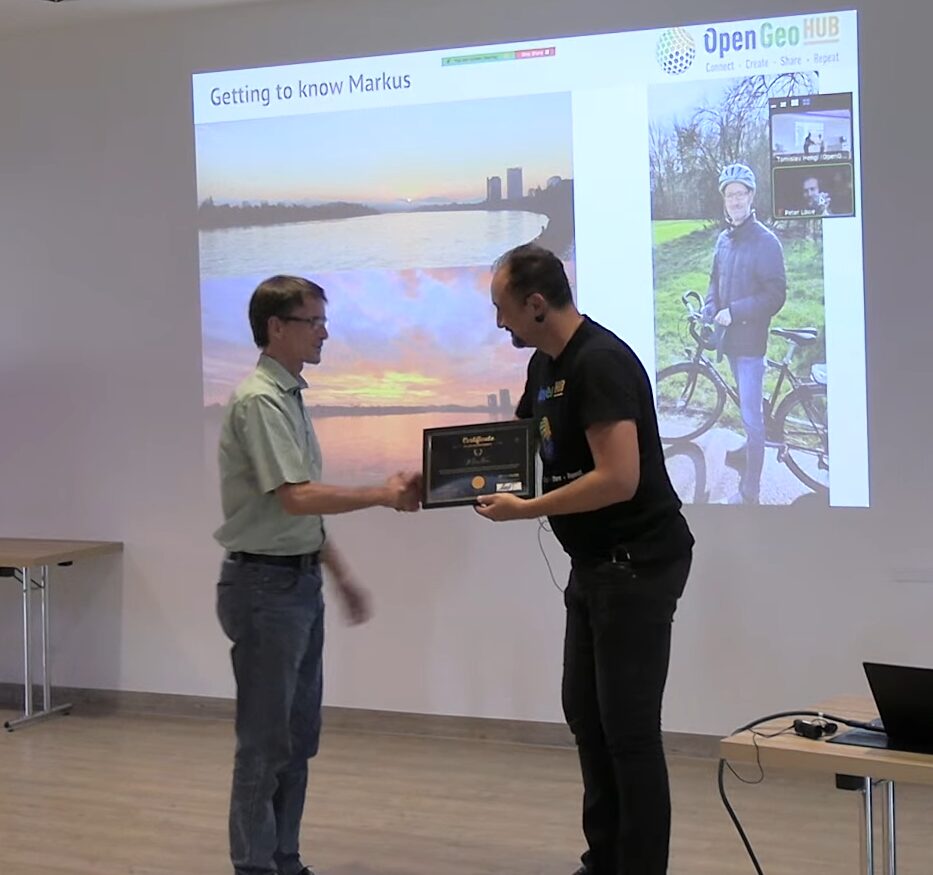
Award handover by Tom for Markus
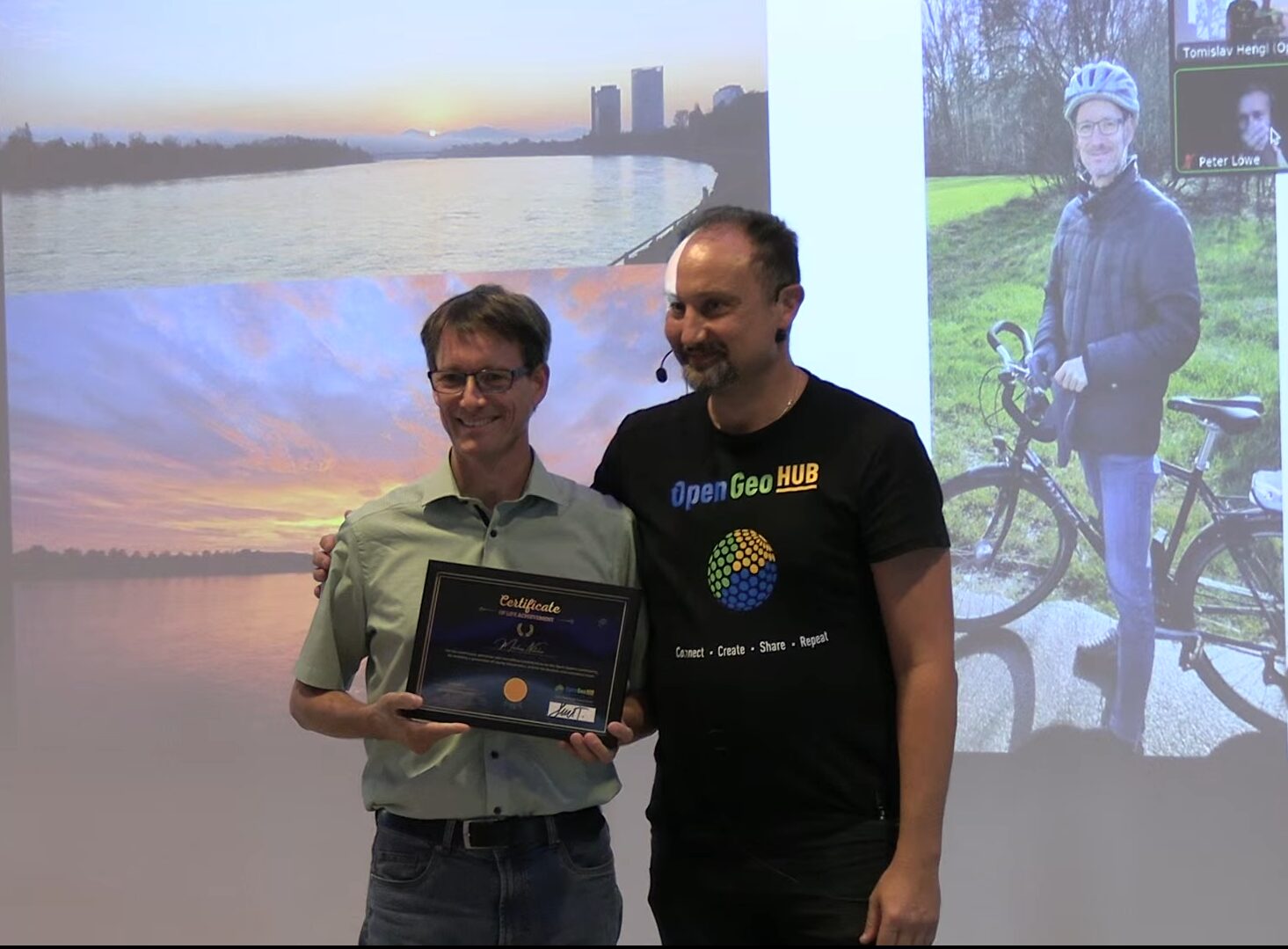
Tom and Markus
Thank you. So, Markus Neteler, you’re a real giant of open source GIS and we are so grateful to you for everything you have done. And this is not your retirement. This is just a little moment in time and space where we want to tell you that we’re really grateful for everything you have done and you will always stay in our hearts and you’re always welcome to come back to the summer schools. And so one more time, it’s not the retirement. We still expect a lot of things from you. And please come here and accept this Life Achievement Award from the Open Geo Heart Foundation. Thank you very much. Thank you.
If you want to say a few words to everyone, we can give you the microphone.
Thank-you response by Markus Neteler
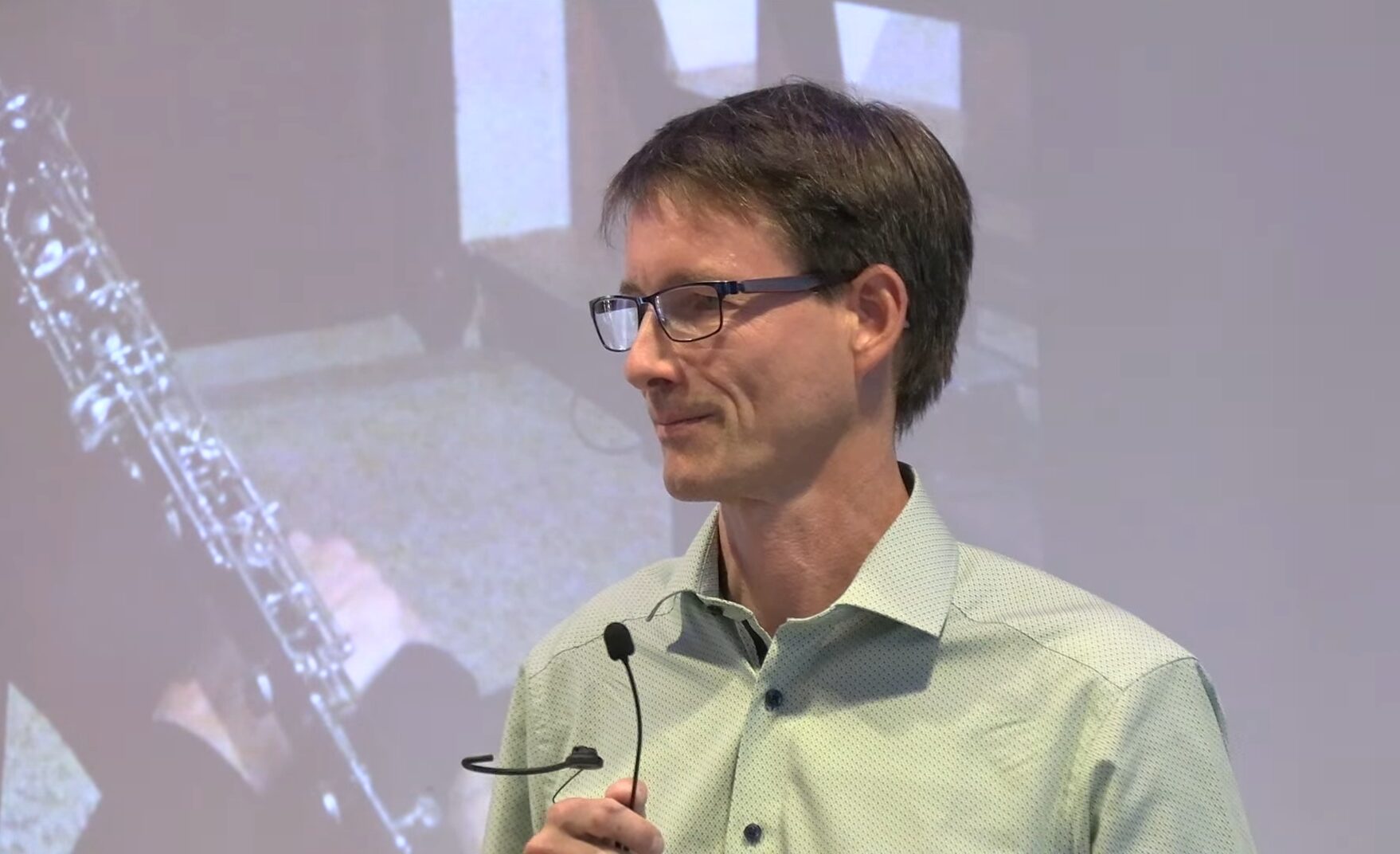
Thank-you remarks by Markus
Yeah, thank you very much. I’m quite overwhelmed, to be honest. Thank you for selecting me for this award. I didn’t quite expect it. Of course, I got some hints. Before, be prepared, be here in Germany because I just came back from FOSS4G, I think two days ago. And it will be a surprise, you said. And so it was a surprise. It is a surprise and I’m really, yeah, I only know the Italian word “commosso”. You can help me what it is in English. Moved. Yes, moved it is. So I moved that people refer to me.
It’s Tom, Peter and Edzer that, yeah, you reflect on my life, which has been, of course, intensive like everybody’s life, but it has been dedicated to this open source topic for a long, long time. And apparently I can’t do differently because I like it too much. You have crisis occasionally, but then you have your friends. And this is what I would like to say to you, that especially this part of friendship is maybe the most important one I could face in my life by building up communities.
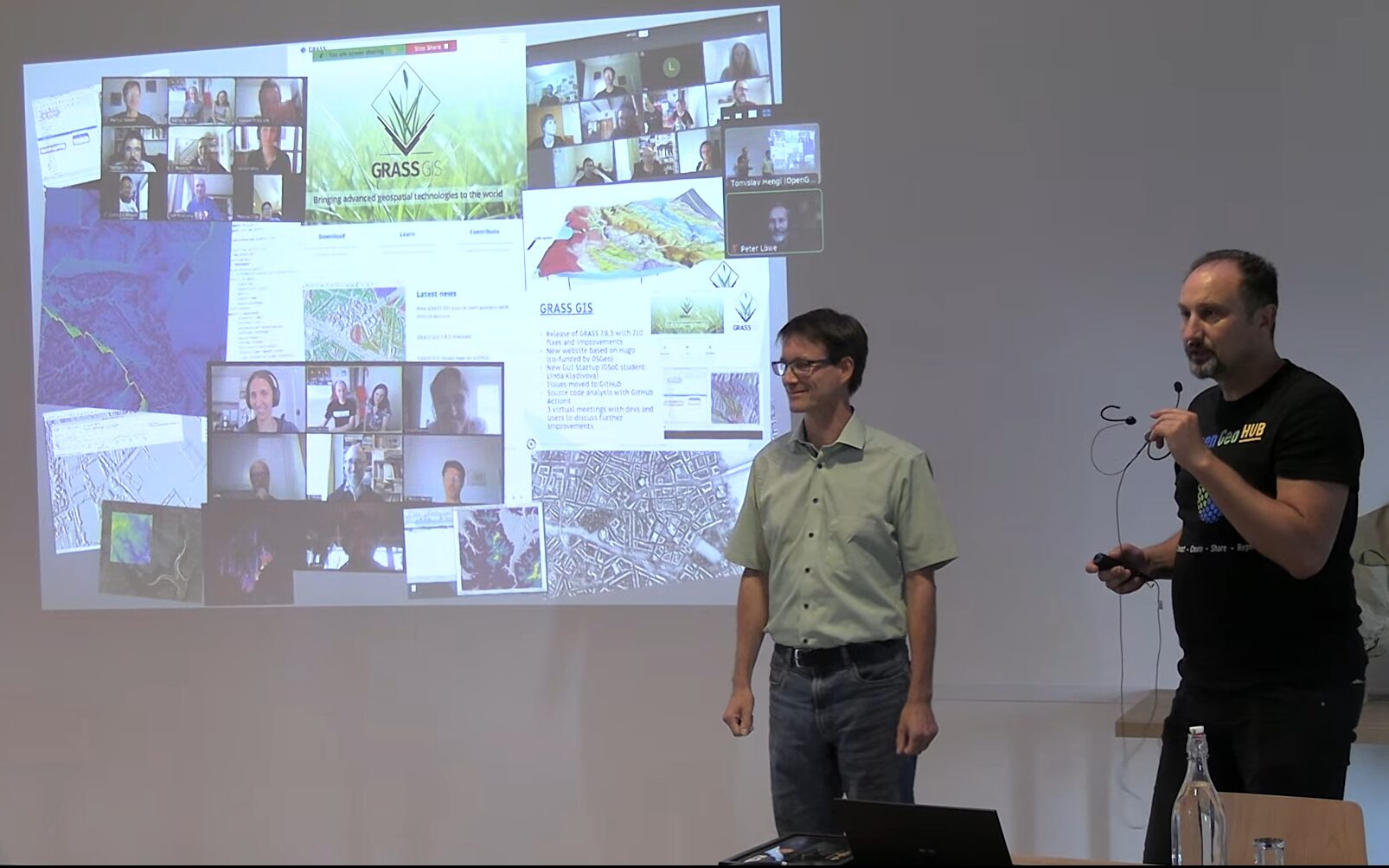
The role of GRASS GIS in Markus’ life
I mean, I’m just a small contributor. There were many more meetings and this frequent gathering, coming together, sharing ideas, talking to each other, helping each other especially. This is also a very important part of open source thinking, I would say, free and open source thinking, that you share and things do not get less, but they get more by sharing and you gain from that.
And this is something which brings you forward from one to the next. I’ve done academia. I was quite tempted to stay in academia, to be honest. Then I decided differently and I went to set up a private company with Hinrich and Till.

GRASS GIS community sprint in Prague
This is also quite interesting. Let’s say in a company you can still do academic stuff. We are partners in Horizon projects, for example, or national research projects. So that means one thing doesn’t have to exclude the other one. And this was possibly the part which I liked most, to combine things, to combine ideas, to get people together as much as I can, to contribute and so on.
In this regard, I’m very happy that I’m here and that I do not have to retire, which I could consider, but I guess I’m too young for this and so I will go on and we’ll try to deliver more in this part of the world, maybe elsewhere. Luckily with remote connection, friends, you have seen the good old GRASS map from, when was it? I don’t remember, 2009 or something. Lovingly handcrafted in a text editor this website back then. But people were already distributed all over the world and collaborating and this is what I like most.

GRASS GIS folks together
Last week in Florence we had exactly the same feeling, people coming together, new people I’ve never seen before. We could talk, we could share ideas and this is something which is really nice. I’m not really prepared for a speech so I would just like to thank you all and I really enjoyed what you have done for me today. Thank you very much.
Tom Hengl outro
We have a little happy hour downstairs at the restaurant and I will just play some of the photos. We pile up all the photos we could find, so just some reflections and we have to close also now the summer school. The summer school is officially closed.
Thank you, Markus.
 Follow
 Follow